Visio-spatial intelligence in athletes: comparison of field hockey players and non-athletes
Medical hypothesis discovery and innovation in ophthalmology,
Vol. 15 No. 2 (2026),
13 August 2026
,
Page 90-99
https://doi.org/10.51329/mehdiophthal1542
Abstract
Background: Visio-spatial intelligence (VSI) plays an important role in athletic performance and may vary according to sport-specific training exposure. However, there is limited research comparing VSI between field hockey players and non-athletes using a comprehensive test battery that assesses accommodation facility, saccadic eye movements, speed of recognition, visual memory, hand-eye coordination, and peripheral awareness. Most studies have focused on mixed sports or recreational activities, leaving sport-specific VSI profiles in field hockey insufficiently characterized. This study aimed to compare VSI between field hockey players and non-athletes.Methods: A comparative analytical cross-sectional study used a convenience sampling approach, and recruited 80 adults aged 18–34 years from the Zululand District, KwaZulu-Natal, South Africa, including 40 field hockey athletes and 40 non-athlete controls. VSI was assessed across six domains: accommodation facility, saccadic eye movements, speed of recognition, visual memory, hand-eye coordination, and peripheral awareness. All participants underwent a comprehensive ocular examination performed by a registered optometrist to assess their ocular status. Visual assessments were conducted using Spectrum Eyecare software to identify any visual abnormalities or limitations in either eye.
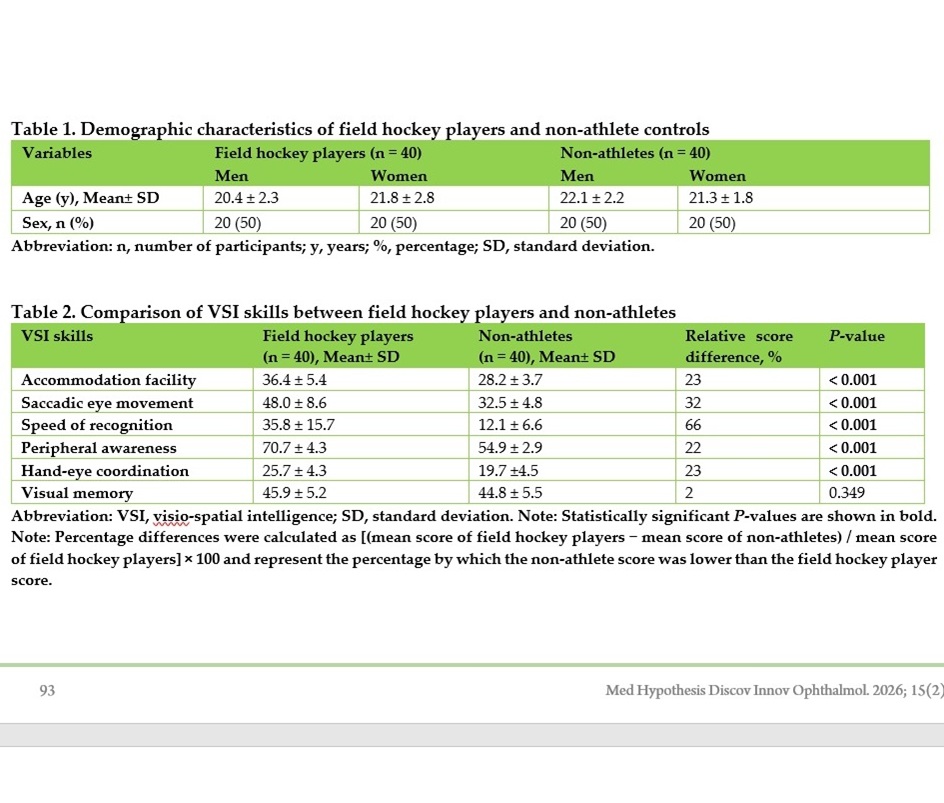
Results: Eighty participants completed the study, with an equal distribution of field hockey athletes and non-athlete controls (n = 40 each) and an equal sex distribution (20 men and 20 women per group). Mean (SD) age was 20.4 (2.3) and 21.8 (2.8) years for men and women field hockey players, respectively, and 22.1 (2.2) and 21.3 (1.8) years for men and women non-athletes, respectively. Field hockey athletes demonstrated significantly superior VSI in accommodation facility, saccadic eye movements, speed of recognition, peripheral awareness, and hand-eye coordination than non-athletes (all P < 0.001), with performance differences ranging from 22% to 66%. In contrast, visual memory did not differ significantly between groups (45.9 [5.2] vs. 44.8 [5.5]; P > 0.05), representing only a 2% difference. Overall, field hockey athletes demonstrated significantly better VSI than non-athletes in all assessed domains except visual memory.
Conclusions: Field hockey players demonstrated superior performance across five of the six VSI domains evaluated, including accommodative facility, speed of recognition, peripheral awareness, hand-eye coordination, and saccadic eye movements, whereas visual memory did not differ significantly from that of non-athletes. These findings suggest that participation in field hockey is associated with higher performance in selected visuomotor and perceptual tasks. Nevertheless, the comparable visual memory performance observed between groups indicates that the association between field hockey participation and performance may differ across VSI domains. Visuo-spatial assessment may therefore warrant further evaluation as a potential adjunct to talent identification and athlete development programmes.
- Abstract Viewed: 0 times
- Full Text PDF Downloaded: 0 times


