Essential visual skills for cricket performance and talent development: a review of the literature
Medical hypothesis discovery and innovation in ophthalmology,
Vol. 15 No. 2 (2026),
13 August 2026
,
Page 144-155
https://doi.org/10.51329/mehdiophthal1545
Abstract
Background: Vision is fundamental to cricket performance, enabling players to process complex visual information and execute accurate motor responses under severe temporal constraints. Although numerous visual skills have been associated with cricket performance, uncertainty remains regarding their relative importance and practical application in talent identification and player development. This review critically examines the visual skills associated with cricket performance and evaluates their relevance for talent identification and player development.Methods: A structured literature search was conducted across multiple electronic sources, including PubMed/MEDLINE, ScienceDirect, Google Scholar, NRC-CISTI, SPORTDiscus via EBSCOhost, and the Cochrane Database of Systematic Reviews. Where available, Medical Subject Headings (MeSH), together with free-text keywords related to cricket, vision, and visual performance were combined using Boolean operators. Eligible English-language sources included cross-sectional, longitudinal, cohort, and intervention studies; narrative and systematic reviews; and relevant books, book chapters, dissertations, theses, and conference proceedings. Retrieved publications were screened for eligibility, and data were extracted and synthesized narratively according to the visual skills examined and their reported associations with cricket performance, talent identification, and player development. For narrative synthesis, the identified visual skills were conceptually classified into visual hardware skills, comprising fundamental, non-task-specific optometric and binocular visual abilities, and visual software skills, encompassing task-related gaze-control, visual-information-processing, perceptual-cognitive, and visuomotor abilities.
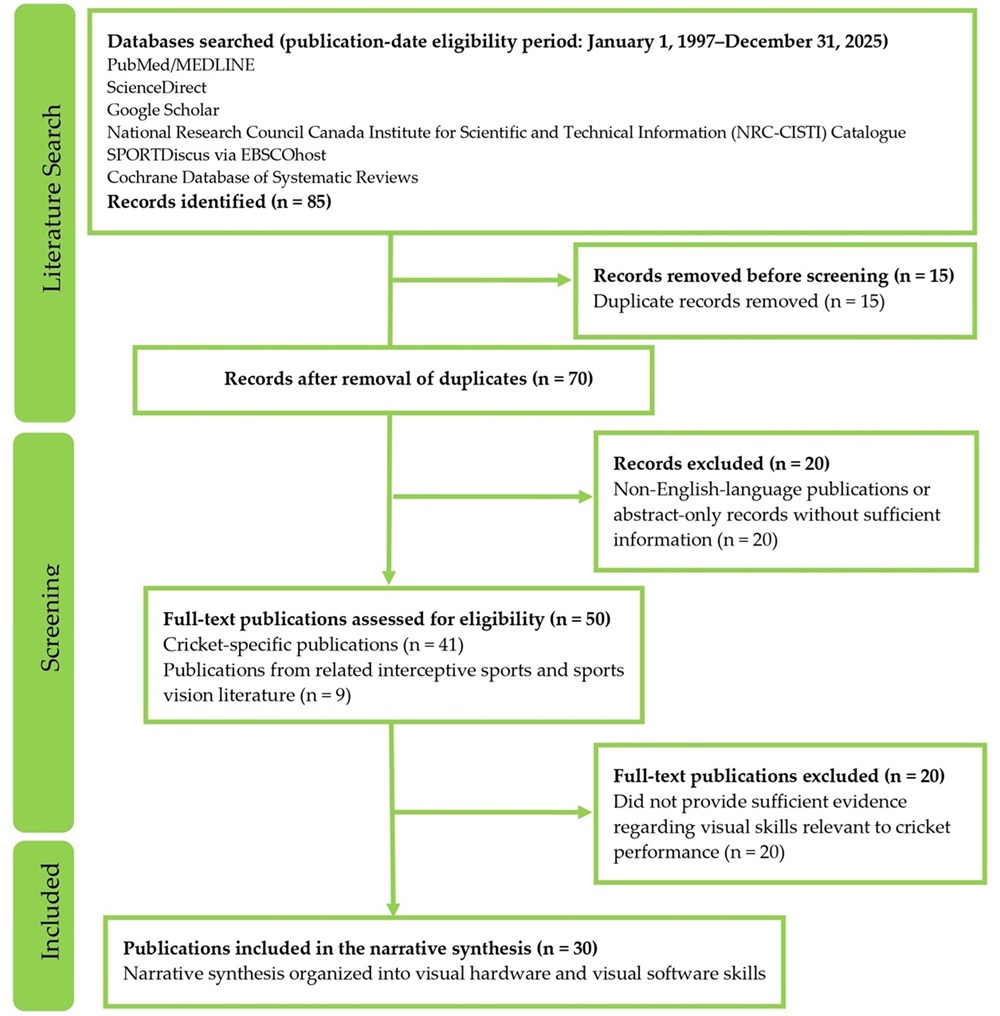
Results: A total of 85 records were identified through the literature search, of which 15 duplicates were removed. Of the 70 records screened, 50 underwent full-text assessment, and 30 publications met the inclusion criteria and were included in the final narrative synthesis. The identified visual skills were organized into two broad conceptual categories: visual hardware skills, comprising fundamental, non-task-specific optometric and binocular visual abilities, and visual software skills, encompassing task-related gaze-control, visual-information-processing, perceptual-cognitive, and visuomotor abilities. The available literature suggested that these complementary skill domains may contribute to cricket performance, with visual hardware skills supporting visual input and visual software skills supporting the interpretation and translation of visual information into sport-specific motor responses. However, the strength and directness of the evidence varied across individual skills.
Conclusions: This review highlights the possible complementary roles of visual hardware and visual software skills in cricket performance and provides a conceptual framework for examining the sport’s visual demands. The 14 visual skills identified from the available literature may inform the future development and evaluation of cricket-specific visual assessment batteries and targeted vision training programs. Further direct research is required to determine whether assessment or enhancement of these skills improves talent identification, player development, or performance in competitive cricket.
- Abstract Viewed: 0 times
- Full Text PDF Downloaded: 0 times


