Comparison of U.S. FDA premarket approval studies between two non-diffractive extended depth of focus lenses (AcrySof IQ Vivity versus TECNIS PureSee)
Medical hypothesis discovery and innovation in ophthalmology,
Vol. 15 No. 2 (2026),
13 August 2026
,
Page 156-172
https://doi.org/10.51329/mehdiophthal1546
Abstract
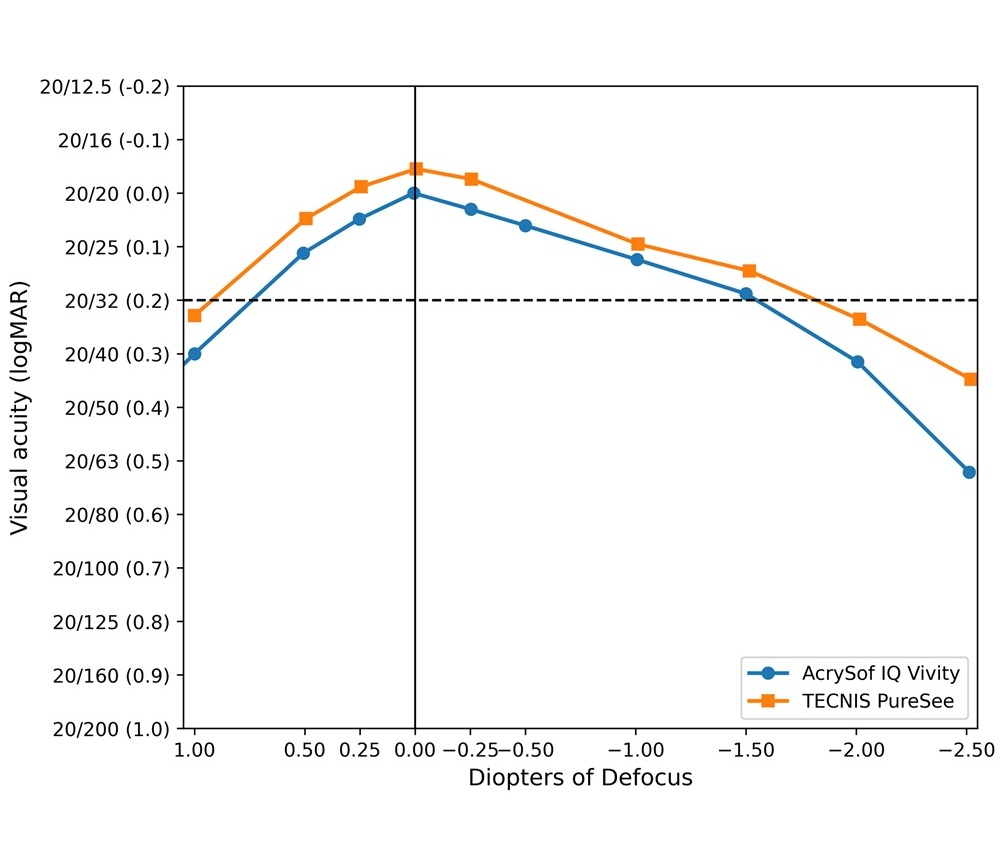
Background: Several recent clinical studies have directly compared TECNIS PureSee with lenses from the Vivity platform; however, direct comparative clinical data specifically involving AcrySof IQ Vivity remain limited. Therefore, we aimed to indirectly compare the visual and patient-reported outcomes of two non-diffractive extended depth of focus (EDOF) intraocular lenses (IOLs), AcrySof IQ Vivity and TECNIS PureSee, using data from their respective FDA premarket approval (PMA) studies.Methods: In this indirect cross-trial comparison, aggregate 6-month outcomes were compared from the FDA Summary of Safety and Effectiveness Data for the Vivity (107 implanted subjects) and PureSee (116 subjects in the intent-to-treat population; 115 in the safety population) PMA studies. The principal binocular visual-acuity threshold comparisons included 106 Vivity subjects from the All-Implanted population and 113 PureSee subjects from the Safety Population with observed 6-month data. Both were prospective, randomized, masked trials of bilateral implantation against a monofocal control from the same manufacturer. Outcomes included binocular visual acuity thresholds at distance, intermediate, and near, depth of focus at the 0.20 logarithm of the minimum angle of resolution (logMAR) threshold, mesopic contrast sensitivity, ISO 11979-7 safety endpoints, visual symptoms, and spectacle independence. Categorical visual acuity outcomes were compared using chi-square or Fisher’s exact tests, with absolute risk differences and 95% confidence intervals (CIs) and Holm adjustment for multiple comparisons. Contrast sensitivity, visual symptoms, spectacle independence, and defocus curves were summarized descriptively.
Results: At distance, the PureSee FDA trial reported more subjects reaching 0.00 logMAR or better for uncorrected distance visual acuity (68.1% versus 44.3%; risk difference [RD], -23.8 percentage points [pp]; 95% CI, -35.8 to -10.7; Holm-adjusted P < 0.05) and best-corrected distance visual acuity (92.0% versus 73.6%; RD, -18.5 pp; 95% CI, -28.3 to -8.6; Holm-adjusted P < 0.05). At intermediate distance, the Vivity FDA trial reported more subjects reaching distance-corrected intermediate visual acuity of 0.00 logMAR or better (40.6% versus 10.6%; RD, +29.9 pp; 95% CI, +18.6 to +40.4; Holm-adjusted P < 0.001). No near-vision threshold comparison remained significant after Holm adjustment. Monocular depth of focus was 1.53 D for Vivity and 1.77 D for PureSee, representing gains of +0.54 D and +0.64 D over their respective monofocal controls. Descriptively, more Vivity eyes were unable to detect the mesopic contrast reference pattern at 6 and 12 cpd with and without glare. Visual symptoms and spectacle independence were also reported descriptively because the trials used different questionnaires. Each trial met the safety and performance endpoint limits applicable to its respective ISO 11979-7 edition.
Conclusions: At the 0.00 logMAR threshold, PureSee reported higher proportions of subjects reaching corrected and uncorrected distance acuity, while Vivity reported a higher proportion reaching distance-corrected intermediate acuity. No near-vision threshold difference remained significant after multiplicity adjustment. Contrast sensitivity and patient-reported outcomes were interpreted descriptively because of differences in testing and questionnaire methods. Overall, the two FDA trials showed different patterns of visual performance, supporting the need for prospective head-to-head comparison.
- Abstract Viewed: 0 times
- Full Text PDF Downloaded: 0 times


