Binocular vision dysfunction after polytrauma
Medical hypothesis, discovery & innovation in optometry,
Vol. 7 No. 1 (2026),
27 May 2026
,
Page 15-22
https://doi.org/10.51329/mehdioptometry241
Abstract
Background: Binocular vision dysfunction is frequently overlooked in polytrauma care despite its established impact on reading, driving, and return to work. We aimed to determine the prevalence and patterns of binocular vision dysfunction in polytrauma patients with ocular involvement and to identify independent clinical predictors.Methods: We conducted a retrospective cohort study of adults (aged 18 years or older) admitted to Sina Hospital Trauma Center, Tehran between January 2021 and December 2023 with an Injury Severity Score (ISS) 16 or more and ophthalmology-confirmed ocular involvement. Four binocular parameters; near point of convergence, stereoacuity, fusional vergence amplitudes, and accommodative facility, were extracted from consultation records when available. Prevalence estimates were calculated using the Wilson score method, and multivariable logistic regression identified independent predictors.
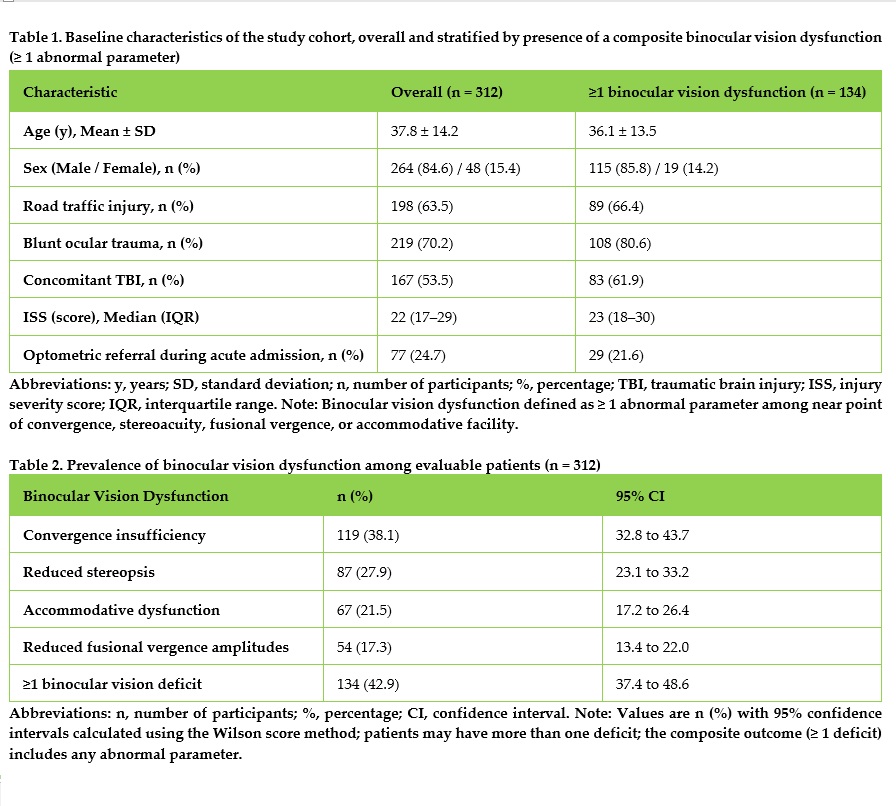
Results: Among 2923 polytrauma admissions, 438 patients (15.0%) had ocular involvement; 312 (71.2%) had complete binocular data (mean [standard deviation] age 37.8 [14.2] years; 84.6% [n = 264] male). At least one binocular dysfunction was identified in 134 patients (42.9%; 95% confidence interval [CI], 37.4-48.6). Convergence insufficiency was most common (n = 119, 38.1%; 95% CI, 32.8–43.7), followed by reduced stereopsis (n = 87, 27.9%; 95% CI, 23.1–33.2), accommodative dysfunction (n = 67, 21.5%; 95% CI, 17.2–26.4), and reduced fusional vergence amplitude (n = 54, 17.3%; 95% CI, 13.4–22.0). Only 24.7% (n = 77) of patients received formal optometric referral during acute admission. Independent predictors were blunt orbital trauma (adjusted odds ratio [aOR] 2.81, 95% CI, 1.67–4.73), concomitant traumatic brain injury (aOR 2.14, 95% CI, 1.29–3.55), and age 18-35 years (aOR 1.92, 95% CI, 1.12–3.28) (all P < 0.05).
Conclusions: Binocular vision dysfunction affects nearly half of polytrauma patients with ocular involvement yet is substantially under-recognized and under-referred. Incorporating a brief binocular screening into routine post-trauma ophthalmologic assessment may represent a low-cost strategy to mitigate long-term visual and functional disability. Future prospective, multicenter studies employing standardized optometric assessment protocols and longitudinal follow-up are warranted to better define the natural history of these observed binocular dysfunctions and to evaluate the impact of early detection and targeted intervention on functional outcomes.
- multiple traumas
- polytrauma
- injury severity scores
- ISS score
- binocular vision
- ocular convergence
- stereopsis
- ocular motility disorder
- convergence insufficiency
- retrospective study
References
Pelletier J, Reagan K, McLeod S, Kronk N, Dickson K, Ohman K, Santos M. Epidemiology of ocular trauma in limited-resource settings: a narrative review. Front Med (Lausanne). 2025 Aug 25;12:1585527. doi: 10.3389/fmed.2025.1585527. PMID: 40927196; PMCID: PMC12415046.
Daryabari SH, Jadidi K, Torabi H, Hassani M, Kiarudi MY, Saeedifar M. Refractive and visual outcomes of traumatic cataract surgery: a ten-year perspective. Medical hypothesis, discovery & innovation in optometry. 2024;5(3):112-8. doi: 10.51329/mehdioptometry205.
Hashemi A, Khabazkhoob M, Mehri A, Yekta A, Mortazavi A, Hashemi H. Epidemiology of Ocular Trauma in the Elderly: A Population-Based Study. J Curr Ophthalmol. 2023 Aug 11;35(1):79-85. doi: 10.4103/joco.joco_53_23. PMID: 37680290; PMCID: PMC10481976.
Hashemi H, Pakzad R, Khabazkhoob M, Yekta A, Emamian MH, Fotouhi A. Prevalence of ocular trauma in 6-12-year-old children living in Shahroud, Iran. BMC Ophthalmol. 2022 Jul 26;22(1):320. doi: 10.1186/s12886-022-02541-5. PMID: 35883120; PMCID: PMC9316335.
Hashemi H, Khabazkhoob M, Emamian MH, Shariati M, Mohazzab-Torabi S, Fotouhi A. Past History of Ocular Trauma in an Iranian Population-Based Study: Prevalence and its Associated Factors. Middle East Afr J Ophthalmol. 2015 Jul-Sep;22(3):377-82. doi: 10.4103/0974-9233.159766. PMID: 26180480; PMCID: PMC4502185.
Mir A, Baseri MM, Farmanfarma KK. Factors affecting ocular trauma in Iran: A systematic review study. Health Sci Rep. 2024 Aug 30;7(9):e2281. doi: 10.1002/hsr2.2281. PMID: 39221056; PMCID: PMC11362837.
Merezhinskaya N, Mallia RK, Park D, Bryden DW, Mathur K, Barker FM 2nd. Visual Deficits and Dysfunctions Associated with Traumatic Brain Injury: A Systematic Review and Meta-analysis. Optom Vis Sci. 2019 Aug;96(8):542-555. doi: 10.1097/OPX.0000000000001407. PMID: 31343512.
Dutta P. Characteristics of binocular vision and oculomotor function among sports-concussed athletes. Indian J Ophthalmol. 2023 May;71(5):2076-2082. doi: 10.4103/ijo.IJO_1932_22. PMID: 37203084; PMCID: PMC10391497.
Winkler SL, Finch D, Wang X, Toyinbo P, Marszalek J, Rakoczy CM, Rice CE, Pollard K, Rhodes MA, Eldred K, Llanos I, Peterson M, Williams M, Zuniga E, White H, Delikat J, Ballistrea L, White K, Cockerham GC. Veterans with Traumatic Brain Injury-related Ocular Injury and Vision Dysfunction: Recommendations for Rehabilitation. Optom Vis Sci. 2022 Jan 1;99(1):9-17. doi: 10.1097/OPX.0000000000001828. PMID: 34882607; PMCID: PMC8720069.
Subramanian PS, Barton JJS, Ranalli P, Smith C, Francis CE, Frishberg B. Consensus Statement on Visual Rehabilitation in Mild Traumatic Brain Injury. Neurol Clin Pract. 2022 Dec;12(6):422-428. doi: 10.1212/CPJ.0000000000200071. PMID: 36540149; PMCID: PMC9757109.
Trieu LH, Lavrich JB. Current concepts in convergence insufficiency. Curr Opin Ophthalmol. 2018 Sep;29(5):401-406. doi: 10.1097/ICU.0000000000000502. PMID: 29994854.
Asadi F, Ramezanghorbani N, Almasi S, Rangraz MH. Eye Injury Registries: A Review on Key Registry Processes. Iran J Public Health. 2021 Dec;50(12):2495-2508. doi: 10.18502/ijph.v50i12.7922. PMID: 36317027; PMCID: PMC9577153.
Saeednejad M, Zafarghandi M, Khalili N, Baigi V, Khormali M, Ghodsi Z, Sharif-Alhoseini M, O'Reilly GM, Naghdi K, Khaleghi-Nekou M, Piri SM, Rahimi-Movaghar V, Bahrami S, Laal M, Mohammadzadeh M, Fakharian E, Pirnejad H, Pahlavanhosseini H, Salamati P, Sadeghi-Bazargani H. Evaluating mechanism and severity of injuries among trauma patients admitted to Sina Hospital, the National Trauma Registry of Iran. Chin J Traumatol. 2021 May;24(3):153-158. doi: 10.1016/j.cjtee.2021.01.009. Epub 2021 Feb 6. PMID: 33640244; PMCID: PMC8173574.
Sharif-Alhoseini M, Zafarghandi M, Rahimi-Movaghar V, Heidari Z, Naghdi K, Bahrami S, Koohi-Habibi S, Laal M, Moradi A, Ghodsi Z, Khormali M, Abdolhoseinzadeh M, Khaleghi-Nekou M, Salamati P. National Trauma Registry of Iran: A Pilot Phase at a Major Trauma Center in Tehran. Arch Iran Med. 2019 Jun 1;22(6):286-292. PMID: 31356094.
Baigi V, Zafarghandi MR, Khormali M, Rahimi-Movaghar V, Salamati P. Data quality and patient coverage at Sina Hospital Trauma Registry affiliated with the National Trauma Registry of Iran. Archives of Trauma Research. 2023 Nov 1;12(3):124-9. doi: 10.48307/atr.2023.178219.
Hildebrand F, Lefering R, Andruszkow H, Zelle BA, Barkatali BM, Pape HC. Development of a scoring system based on conventional parameters to assess polytrauma patients: PolyTrauma Grading Score (PTGS). Injury. 2015 Oct;46 Suppl 4:S93-8. doi: 10.1016/S0020-1383(15)30025-5. PMID: 26542873.
World Health Organization (2022). ‘ICD-10 Version:2019: Superficial injury of head, Fracture of skull and facial bones, and Injury of eye and orbit’. Available at: https://icd.who.int/browse10/2019/en#S00.1 (Accessed: April 10, 2026)
Munakomi S, Margetis K, Iverson LM. Glasgow Coma Scale. 2025 Jun 23. In: StatPearls [Internet]. Treasure Island (FL): StatPearls Publishing; 2026 Jan–. PMID: 30020670.
Hashemi H, Pakbin M, Ali B, Yekta A, Ostadimoghaddam H, Asharlous A, Aghamirsalim M, Khabazkhoob M. Near Points of Convergence and Accommodation in a Population of University Students in Iran. J Ophthalmic Vis Res. 2019 Jul 18;14(3):306-314. doi: 10.18502/jovr.v14i3.4787. PMID: 31660110; PMCID: PMC6815340.
Lee SY, Koo NK. Change of stereoacuity with aging in normal eyes. Korean J Ophthalmol. 2005 Jun;19(2):136-9. doi: 10.3341/kjo.2005.19.2.136. PMID: 15988931.
Antona B, Barrio A, Barra F, Gonzalez E, Sanchez I. Repeatability and agreement in the measurement of horizontal fusional vergences. Ophthalmic Physiol Opt. 2008 Sep;28(5):475-91. doi: 10.1111/j.1475-1313.2008.00583.x. PMID: 18761485.
Wajuihian SO. Normative values for clinical measures used to classify accommodative and vergence anomalies in a sample of high school children in South Africa. J Optom. 2019 Jul-Sep;12(3):143-160. doi: 10.1016/j.optom.2018.03.005. Epub 2018 Jun 19. PMID: 29887298; PMCID: PMC6612036.
Convergence Insufficiency Treatment Trial Study Group. Randomized clinical trial of treatments for symptomatic convergence insufficiency in children. Arch Ophthalmol. 2008 Oct;126(10):1336-49. doi: 10.1001/archopht.126.10.1336. PMID: 18852411; PMCID: PMC2779032.
Lakshmanan Y, George RJ. Stereoacuity in mild, moderate and severe glaucoma. Ophthalmic Physiol Opt. 2013 Mar;33(2):172-8. doi: 10.1111/opo.12021. Epub 2013 Jan 9. PMID: 23297812.
GarcÃa A, Cacho P, Lara F, MegÃas R. The relation between accommodative facility and general binocular dysfunction. Ophthalmic Physiol Opt. 2000 Mar;20(2):98-104. PMID: 10829131.
Chen N, Liao M, Yang C, Liu L. Accommodation and stereopsis in adults with traumatic brain injury. Clin Exp Optom. 2020 Nov;103(6):877-884. doi: 10.1111/cxo.13056. Epub 2020 Mar 12. PMID: 32166808.
Rauchman SH, Zubair A, Jacob B, Rauchman D, Pinkhasov A, Placantonakis DG, Reiss AB. Traumatic brain injury: Mechanisms, manifestations, and visual sequelae. Front Neurosci. 2023 Feb 23;17:1090672. doi: 10.3389/fnins.2023.1090672. PMID: 36908792; PMCID: PMC9995859.
Mona-Lisa M, Kaisa M, Taina N, Antti H, Ivan M, Susanna M, Jan J. Evaluation of Visual Disturbances After Mild Traumatic Brain Injury-A One-Year Follow-up Study. J Head Trauma Rehabil. 2025 May-Jun 01;40(3):E208-E215. doi: 10.1097/HTR.0000000000001010. Epub 2024 Nov 7. PMID: 39531319; PMCID: PMC12594135.
McDonald MA, Holdsworth SJ, Danesh-Meyer HV. Eye Movements in Mild Traumatic Brain Injury: Clinical Challenges. J Eye Mov Res. 2022 Jun 14;15(2):10.16910/jemr.15.2.3. doi: 10.16910/jemr.15.2.3. PMID: 36439910; PMCID: PMC9691323.
McDonald MA, Holdsworth SJ, Danesh-Meyer HV. Eye Movements in Mild Traumatic Brain Injury: Ocular Biomarkers. J Eye Mov Res. 2022 Jun 16;15(2):10.16910/jemr.15.2.4. doi: 10.16910/jemr.15.2.4. PMID: 36439911; PMCID: PMC9682364.
Viswanathan S, Port N, Master CL, Pardue MT. Impact of traumatic brain injury on vision. Vision Res. 2023 Mar;204:108176. doi: 10.1016/j.visres.2022.108176. Epub 2022 Dec 23. PMID: 36566559; PMCID: PMC10695695.
Almutairi NM. Visual Dysfunctions in Mild Traumatic Brain Injury: A Focus on Accommodative System Impairments. Life (Basel). 2025 May 6;15(5):744. doi: 10.3390/life15050744. PMID: 40430172; PMCID: PMC12113616.
Smaakjær P, Wachner LG, Rasmussen RS. Vision therapy improves binocular visual dysfunction in patients with mild traumatic brain injury. Neurol Res. 2022 May;44(5):439-445. doi: 10.1080/01616412.2021.2000825. Epub 2021 Nov 15. PMID: 34781837.
Fortenbaugh FC, Gustafson JA, Fonda JR, Fortier CB, Milberg WP, McGlinchey RE. Blast mild traumatic brain injury is associated with increased myopia and chronic convergence insufficiency. Vision Res. 2021 Sep;186:1-12. doi: 10.1016/j.visres.2021.04.004. Epub 2021 May 14. PMID: 34000559; PMCID: PMC8273108.
Winkler SL, Finch D, Llanos I, Delikat J, Marszalek J, Rice C, Rakoczy C, Wang X, Pollard K, Cockerham GC. Retrospective Analysis of Vision Rehabilitation for Veterans With Traumatic Brain Injury-Related Vision Dysfunction. Mil Med. 2023 Aug 29;188(9-10):e2982-e2986. doi: 10.1093/milmed/usad120. PMID: 37186008.
Winkler SL, Marszalek J, Wang X, Finch D, Rakoczy C, Delikat J, Kelleher V, Williams M, Zuniga E, Rice C, Pollard K, Cockerham G. Veterans with Traumatic Brain Injury-related Ocular Injury and Vision Dysfunction: Vision Rehabilitation Utilization. Optom Vis Sci. 2022 Jan 1;99(1):3-8. doi: 10.1097/OPX.0000000000001824. Erratum in: Optom Vis Sci. 2022 Mar 1;99(3):319. doi: 10.1097/OPX.0000000000001870. PMID: 34882609.
Zhang K, Truong T, He CH, Parsikia A, Mbekeani JN. Traumatic Brain Injury in Admitted Patients with Ocular Trauma. Turk J Ophthalmol. 2024 Aug 28;54(4):212-222. doi: 10.4274/tjo.galenos.2024.27737. Epub 2024 Aug 7. PMID: 39108021; PMCID: PMC11590704.
Zima L, Moore AN, Smolen P, Kobori N, Noble B, Robinson D, Hood KN, Homma R, Al Mamun A, Redell JB, Dash PK. The evolving pathophysiology of TBI and the advantages of temporally-guided combination therapies. Neurochem Int. 2024 Nov;180:105874. doi: 10.1016/j.neuint.2024.105874. Epub 2024 Oct 2. PMID: 39366429; PMCID: PMC12011104.
Ivancevic VG. New mechanics of traumatic brain injury. Cogn Neurodyn. 2009 Sep;3(3):281-93. doi: 10.1007/s11571-008-9070-0. Epub 2008 Nov 23. PMID: 19031012; PMCID: PMC2727160.
Lin CH, Lin PC, Hsieh CH. Extraocular Muscle Trauma: Clinical Approach to Diagnosis and Surgical Management of Rectus Muscle Disruptions. World J Plast Surg. 2025;14(2):46-55. doi: 10.61186/wjps.14.2.46. PMID: 41019245; PMCID: PMC12476249.
Hârtie VL, Anton N, Boișteanu O, Comanescu MP, Pătrășcanu E, Bologa E, Șulea D, Danielescu C, Turliuc MD. Traumatic Brain Injury and Its Ophthalmologic Implications. Rom J Ophthalmol. 2025 Oct-Dec;69(4):475-481. doi: 10.22336/rjo.2025.75. PMID: 41971212; PMCID: PMC13065145.
Sayyed Hoseinian SH, Ebrahimzadeh MH, Peivandi MT, Bagheri F, Hasani J, Golshan S, Birjandinejad A. Injury Patterns among Motorcyclist Trauma Patients: A Cross Sectional Study on 4200 Patients. Arch Bone Jt Surg. 2019 Jul;7(4):367-372. PMID: 31448315; PMCID: PMC6686071.
O'Neil M, Gleitsmann K, Motu'apuaka M, Freeman M, Kondo K, Storzbach D, Kansagara D, Carlson K. Visual Dysfunction in Patients with Traumatic Brain Injury: A Systematic Review [Internet]. Washington (DC): Department of Veterans Affairs (US); 2014 Sep. PMID: 25973512.
Pillay R, Munsamy AJ. A review exploring convergence insufficiency in younger populations and e-devices in the digital era. African Vision and Eye Health. 2021 Jun 14;80(1):12. doi: 10.4102/aveh.v80i1.623.
Kool DR, Blickman JG. Advanced Trauma Life Support. ABCDE from a radiological point of view. Emerg Radiol. 2007 Jul;14(3):135-41. doi: 10.1007/s10140-007-0633-x. Epub 2007 Jun 12. PMID: 17564732; PMCID: PMC1914302.
Mohseni M, Gurnani B, Blair K. Blunt Eye Trauma. 2026 Feb 21. In: StatPearls [Internet]. Treasure Island (FL): StatPearls Publishing; 2026 Jan–. PMID: 29261988.
Scheiman M, Wick B (2008). 'Clinical management of binocular vision: heterophoric, accommodative, and eye movement disorders' Third Edition (pp. 1-695). Lippincott Williams & Wilkins. ISBN-13: 978-0-7817-7784-1; ISBN-10: 0-7817-7784-4.
Gowrisankaran S, Shah AS, Roberts TL, Wiecek E, Chinn RN, Hawash KK, O'Brien MJ, Howell DR, Meehan WP 3rd, Raghuram A. Association between post-concussion symptoms and oculomotor deficits among adolescents. Brain Inj. 2021 Aug 24;35(10):1218-1228. doi: 10.1080/02699052.2021.1959065. Epub 2021 Aug 12. PMID: 34383619; PMCID: PMC8487965.
Hussain SF, Raza Z, Cash ATG, Zampieri T, Mazzoli RA, Kardon RH, Gomes RSM. Traumatic brain injury and sight loss in military and veteran populations- a review. Mil Med Res. 2021 Jul 28;8(1):42. doi: 10.1186/s40779-021-00334-3. PMID: 34315537; PMCID: PMC8317328.
Nakamura K, Fuchigami T, Morioka S. Eye movement training and gaze analysis for a patient with binocular diplopia after traumatic brain injury: a case report. J Med Case Rep. 2023 Dec 18;17(1):551. doi: 10.1186/s13256-023-04221-4. PMID: 38110994; PMCID: PMC10726626.
Harris P, Myers MH. A Pilot Investigation of Visual Pathways in Patients with Mild Traumatic Brain Injury. Neurol Int. 2023 Mar 20;15(1):534-548. doi: 10.3390/neurolint15010032. PMID: 36976675; PMCID: PMC10054811.
Reddy AVC, Mani R, Selvakumar A, Hussaindeen JR. Reading eye movements in traumatic brain injury. J Optom. 2020 Jul-Sep;13(3):155-162. doi: 10.1016/j.optom.2019.10.001. Epub 2019 Nov 26. PMID: 31784207; PMCID: PMC7301197.
Raghuram A, Cotter SA, Gowrisankaran S, Kanji J, Howell DR, Meehan WP 3rd, Shah AS. Postconcussion: Receded Near Point of Convergence is not Diagnostic of Convergence Insufficiency. Am J Ophthalmol. 2019 Oct;206:235-244. doi: 10.1016/j.ajo.2019.04.008. Epub 2019 Apr 17. PMID: 31004592.
- Abstract Viewed: 0 times
- Full Text PDF Downloaded: 0 times