Digital eye strain among the Omani university population: prevalence, contributing factors, and preventive practices
Medical hypothesis, discovery & innovation in optometry,
Vol. 7 No. 1 (2026),
27 May 2026
,
Page 23-30
https://doi.org/10.51329/mehdioptometry242
Abstract
Background: University students are increasingly exposed to prolonged digital device use for academic activities, which places them at risk of digital eye strain (DES). While prevalence is widely reported, limited attention has been given to awareness and preventive practices of students. This study aimed to determine the prevalence of DES, associated behavioral patterns, and preventive practices among university students.Methods: A descriptive cross-sectional study was conducted during the Spring semester of the 2025–2026 academic year at the University of Buraimi, Oman. Using stratified random sampling, 240 undergraduate students were recruited from all four colleges. Data were collected through an online survey comprising demographic characteristics, digital device usage habits, the validated Computer Vision Syndrome Questionnaire (CVS-Q), and items assessing awareness and preventive practices.
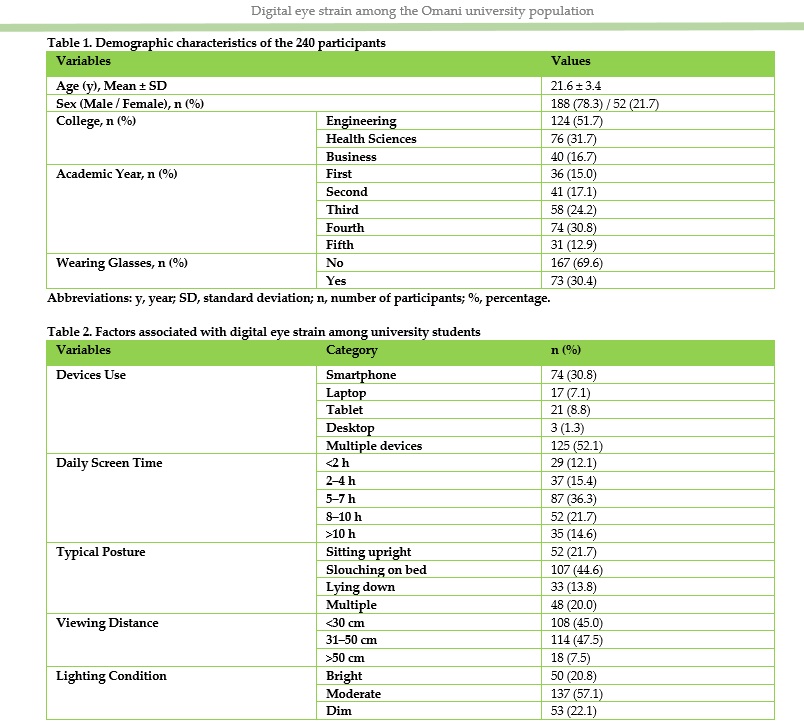
Results: Overall, 58.8% (n = 141) of participants were classified as having DES, with the majority experiencing mild symptoms (n = 89, 37.1%), followed by moderate (n = 40, 16.7%) and severe (n = 12, 5.0%) symptoms. The most commonly reported symptoms were tearing (n = 137, 57.1%), ocular dryness (n = 125, 52.1%), eye redness (n = 115, 47.9%), burning sensation (n = 104, 43.3%), and itching (n = 104, 43.3%). Prolonged screen exposure was common, with 72.5% (n = 174) reporting 5 hours or more of daily use, alongside frequent use of multiple devices and suboptimal ergonomic practices, including close viewing distances and poor posture. Awareness of DES was reported by 37% (n = 87) of participants, yet adoption of preventive practices was inconsistent. A statistically significant association was observed between engagement in preventive practices and lower DES severity (P < 0.05), whereas awareness alone was not significantly associated with symptom severity (P > 0.05).
Conclusions: The findings of this study indicate a 58.8% prevalence of DES among Omani university students. Prolonged screen time emerged as a key predictive factor. Awareness of DES was limited, and adherence to preventive practices remained low. These results underscore the need for targeted educational interventions on eye health, emphasizing simple and effective strategies such as the 20-20-20 rule to reduce the burden of DES among university students.
- online learning
- distance education
- eyestrain
- eyedrop
- smartphones
- handheld computer
- screen exposure
- postures
- primary disease prevention
- questionnaire
- disease frequency survey
- university
- students
References
Haleem A, Javaid M, Qadri MA, Suman R. Understanding the role of digital technologies in education: A review. Sustainable operations and computers. 2022 Jan 1;3:275-85. doi: 10.1016/j.susoc.2022.05.004.
Alenezi M, Wardat S, Akour M. The need of integrating digital education in higher education: Challenges and opportunities. Sustainability. 2023 Mar 8;15(6):4782. doi: 10.3390/su15064782.
Kaewpradit K, Ngamchaliew P, Buathong N. Digital screen time usage, prevalence of excessive digital screen time, and its association with mental health, sleep quality, and academic performance among Southern University students. Front Psychiatry. 2025 Mar 24;16:1535631. doi: 10.3389/fpsyt.2025.1535631. PMID: 40195967; PMCID: PMC11973388.
Cantó-Sancho N, Ronda E, Cabrero-GarcÃa J, Casati S, Carta A, Porru S, SeguÃ-Crespo M. Rasch-Validated Italian Scale for Diagnosing Digital Eye Strain: The Computer Vision Syndrome Questionnaire IT©. Int J Environ Res Public Health. 2022 Apr 8;19(8):4506. doi: 10.3390/ijerph19084506. PMID: 35457379; PMCID: PMC9028942.
Bahkir FA, Grandee SS. Impact of the COVID-19 lockdown on digital device-related ocular health. Indian J Ophthalmol. 2020 Nov;68(11):2378-2383. doi: 10.4103/ijo.IJO_2306_20. PMID: 33120622; PMCID: PMC7774196.
Gupta R, Chauhan L, Varshney A. Impact of E-Schooling on Digital Eye Strain in Coronavirus Disease Era: A Survey of 654 Students. J Curr Ophthalmol. 2021 Jul 5;33(2):158-164. doi: 10.4103/joco.joco_89_20. PMID: 34409226; PMCID: PMC8365579.
Ccami-Bernal F, Soriano-Moreno DR, Romero-Robles MA, Barriga-Chambi F, Tuco KG, Castro-Diaz SD, Nuñez-Lupaca JN, Pacheco-Mendoza J, Galvez-Olortegui T, Benites-Zapata VA. Prevalence of computer vision syndrome: A systematic review and meta-analysis. J Optom. 2024 Jan-Mar;17(1):100482. doi: 10.1016/j.optom.2023.100482. Epub 2023 Oct 30. PMID: 37866176; PMCID: PMC10785422.
Kahal F, Al Darra A, Torbey A. Computer vision syndrome: a comprehensive literature review. Future Sci OA. 2025 Dec;11(1):2476923. doi: 10.1080/20565623.2025.2476923. Epub 2025 Mar 8. PMID: 40055942; PMCID: PMC11901492.
Cantó-Sancho N, Sánchez-Brau M, Ivorra-Soler B, SeguÃ-Crespo M. Computer vision syndrome prevalence according to individual and video display terminal exposure characteristics in Spanish university students. Int J Clin Pract. 2021 Mar;75(3):e13681. doi: 10.1111/ijcp.13681. Epub 2020 Sep 29. Erratum in: Int J Clin Pract. 2021 Dec;75(12):e15017. doi: 10.1111/ijcp.15017. PMID: 32813924.
Gammoh Y. Digital Eye Strain and Its Risk Factors Among a University Student Population in Jordan: A Cross-Sectional Study. Cureus. 2021 Feb 26;13(2):e13575. doi: 10.7759/cureus.13575. PMID: 33815983; PMCID: PMC8007199.
Kaur K, Gurnani B, Nayak S, Deori N, Kaur S, Jethani J, Singh D, Agarkar S, Hussaindeen JR, Sukhija J, Mishra D. Digital Eye Strain- A Comprehensive Review. Ophthalmol Ther. 2022 Oct;11(5):1655-1680. doi: 10.1007/s40123-022-00540-9. Epub 2022 Jul 9. PMID: 35809192; PMCID: PMC9434525.
Alabdulkader B. Effect of digital device use during COVID-19 on digital eye strain. Clin Exp Optom. 2021 Aug;104(6):698-704. doi: 10.1080/08164622.2021.1878843. Epub 2021 Feb 22. PMID: 33689614.
Patni MA, Fatima W, Alshamsi MA, Jama HA, Shafeeq M, Rajiv R, Alsoued MS, George BT, Salama RAA, Elamin AAE, Pandurangan T, Bahutair SN, Ahmad H. Digital eye health and behavioral determinants of screen use among university students in the UAE. Front Digit Health. 2026 Feb 12;8:1719475. doi: 10.3389/fdgth.2026.1719475. PMID: 41769325; PMCID: PMC12936034.
Almudhaiyan TM, Aldebasi T, Alakel R, Marghlani L, Aljebreen A, Moazin OM. The Prevalence and Knowledge of Digital Eye Strain Among the Undergraduates in Riyadh, Saudi Arabia. Cureus. 2023 Apr 3;15(4):e37081. doi: 10.7759/cureus.37081. PMID: 37153239; PMCID: PMC10156438.
Mrayyan MT, Alseid ARH, Ghoolah TS, Al-Shaikh Ali MH, Mrayan M. Investigating the Prevalence of Computer Vision Syndrome (CVS) Among Undergraduate Nursing Students: A Cross-Sectional Study. SAGE Open Nurs. 2023 Aug 2;9:23779608231191883. doi: 10.1177/23779608231191883. PMID: 37546525; PMCID: PMC10399248.
Almuqrashi A, Al-Noumani H, Al-Abri F, Al-Hinai H, Bani Oraba H. The prevalence of computer vision syndrome and associated factors among university students in oman: a cross-sectional study. BMC Public Health. 2025 Aug 6;25(1):2668. doi: 10.1186/s12889-025-23823-9. PMID: 40770326; PMCID: PMC12326581.
Ramteke S, Satgunam P. At what distance should digital devices be viewed? Eye (Lond). 2024 Mar;38(4):815-816. doi: 10.1038/s41433-023-02781-9. Epub 2023 Oct 10. PMID: 37816935; PMCID: PMC10920617.
Lindo-Cano EF, GarcÃa-Monge VA, Castillo-Cadillo KJ, Sánchez-Tirado EA, Távara IM, Morales J. Computer-digital vision syndrome among university students of Lima City. The Open Public Health Journal. 2022 Nov 8;15(1). doi: 10.2174/18749445-v15-e2208104.
Seguà Mdel M, Cabrero-GarcÃa J, Crespo A, Verdú J, Ronda E. A reliable and valid questionnaire was developed to measure computer vision syndrome at the workplace. J Clin Epidemiol. 2015 Jun;68(6):662-73. doi: 10.1016/j.jclinepi.2015.01.015. Epub 2015 Jan 28. PMID: 25744132.
Anbesu EW, Lema AK. Prevalence of computer vision syndrome: a systematic review and meta-analysis. Sci Rep. 2023 Jan 31;13(1):1801. doi: 10.1038/s41598-023-28750-6. PMID: 36720986; PMCID: PMC9888747.
Barzegari S, ArabKermani Z, Mahmoudvand Z, Arpaci I, Shabani F, Najafi AH. Prevalence and contributing factors of computer vision syndrome among university students in Iran: a cross-sectional study. BMC Ophthalmol. 2025 Sep 15;25(1):501. doi: 10.1186/s12886-025-04367-3. PMID: 40954461; PMCID: PMC12434916.
AlQarni AM, AlAbdulKader AM, Alghamdi AN, Altayeb J, Jabaan R, Assaf L, Alanazi RA. Prevalence of Digital Eye Strain Among University Students and Its Association with Virtual Learning During the COVID-19 Pandemic. Clin Ophthalmol. 2023 Jun 20;17:1755-1768. doi: 10.2147/OPTH.S406032. PMID: 37351540; PMCID: PMC10284626.
Zaky ME, Elsayed SM, Alsadaan N, Awad Ali SA, Farghaly SM. Growing challenges in nursing education: prevalence and mediating role of computer vision syndrome in the relationship between visual fatigue and sleep disturbance among nursing students. BMC Nurs. 2025 Dec 25;25(1):91. doi: 10.1186/s12912-025-04167-6. PMID: 41444891; PMCID: PMC12849673.
Al Dandan O, Hassan A, Al Shammari M, Al Jawad M, Alsaif HS, Alarfaj K. Digital Eye Strain Among Radiologists: A Survey-based Cross-sectional Study. Acad Radiol. 2021 Aug;28(8):1142-1148. doi: 10.1016/j.acra.2020.05.006. Epub 2020 Jun 10. PMID: 32532637.
Zeng Z, Shi Z, Hou S, Yan J, Yang R, Li X. Comprehensive effects and dose-response relationship of screen exposure on university students' physical and mental health and academic performance in the digital age: a systematic review and meta-analysis. BMC Public Health. 2026 Mar 18;26(1):1363. doi: 10.1186/s12889-026-27025-9. PMID: 41845332; PMCID: PMC13113371.
Wangsan K, Upaphong P, Assavanopakun P, Sapbamrer R, Sirikul W, Kitro A, Sirimaharaj N, Kuanprasert S, Saenpo M, Saetiao S, Khamphichai T. Self-Reported Computer Vision Syndrome among Thai University Students in Virtual Classrooms during the COVID-19 Pandemic: Prevalence and Associated Factors. Int J Environ Res Public Health. 2022 Mar 28;19(7):3996. doi: 10.3390/ijerph19073996. PMID: 35409679; PMCID: PMC8997620.
Ganne P, Najeeb S, Chaitanya G, Sharma A, Krishnappa NC. Digital Eye Strain Epidemic amid COVID-19 Pandemic - A Cross-sectional Survey. Ophthalmic Epidemiol. 2021 Aug;28(4):285-292. doi: 10.1080/09286586.2020.1862243. Epub 2020 Dec 28. PMID: 33369521.
Barata MJ, Aguiar P, Grzybowski A, Moreira-Rosário A, Lança C. A Review of Digital Eye Strain: Binocular Vision Anomalies, Ocular Surface Changes, and the Need for Objective Assessment. J Eye Mov Res. 2025 Sep 5;18(5):39. doi: 10.3390/jemr18050039. PMID: 40989226; PMCID: PMC12452390.
Gushgari OA, Sayed SH, Elgzar WT. Digital eye strain syndrome among higher education health sciences students in Saudi Arabia: severity and preventive ergonomic practices. PeerJ. 2024 Nov 14;12:e18423. doi: 10.7717/peerj.18423. PMID: 39553709; PMCID: PMC11569780.
Patil A, Bhavya, Chaudhury S, Srivastava S. Eyeing computer vision syndrome: Awareness, knowledge, and its impact on sleep quality among medical students. Ind Psychiatry J. 2019 Jan-Jun;28(1):68-74. doi: 10.4103/ipj.ipj_93_18. Epub 2019 Dec 11. PMID: 31879450; PMCID: PMC6929228.
Zayed HAM, Saied SM, Younis EA, Atlam SA. Digital eye strain: prevalence and associated factors among information technology professionals, Egypt. Environ Sci Pollut Res Int. 2021 May;28(20):25187-25195. doi: 10.1007/s11356-021-12454-3. Epub 2021 Jan 16. PMID: 33454863.
Borromeo AS. Beyond the screen: Lived experiences and coping strategies of educators facing digital eye strain in a Philippine university. Qual Res Med Healthc. 2026 Mar 12;10:100046. doi: 10.1016/j.qrmh.2026.100046. PMID: 42040259; PMCID: PMC13104348.
Kusumesh R, Ambasta A, Venugopal A, Kumari R, Singh P. Visual impact of smartphones: A narrative review of ocular changes and management approaches. Indian J Ophthalmol. 2025 Dec 1;73(12):1723-1728. doi: 10.4103/IJO.IJO_1389_25. Epub 2025 Nov 24. PMID: 41288623; PMCID: PMC12707383.
- Abstract Viewed: 0 times
- Full Text PDF Downloaded: 0 times