“Small In, Large Out” and “Luster”: vision therapy feedback in adults with normal binocular vision
Medical hypothesis, discovery & innovation in optometry,
Vol. 7 No. 3 (2026),
31 October 2026
,
Page 107-115
https://doi.org/10.51329/mehdioptometry251
Abstract
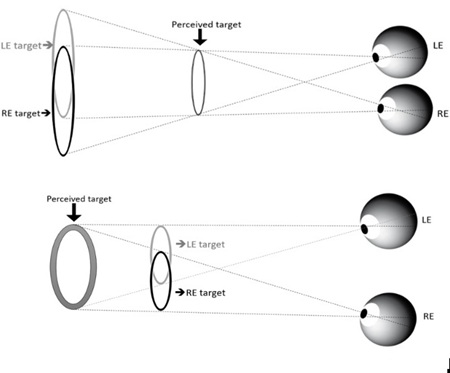
Background: Feedback is an important component of vision therapy, providing information about visual performance and helping reinforce appropriate binocular responses. However, the frequency of different perceptual responses to commonly used vision therapy feedback techniques has not been well characterized in adults with normal binocular vision. This study aimed to determine the frequency and distribution of responses to the Small In, Large Out (SILO) and Luster vision therapy feedback techniques in a population of adults with normal ocular and binocular vision.Methods: This cross-sectional observational study included participants with normal ocular examinations and binocular vision. A comprehensive ophthalmic and binocular vision examination was performed, including assessment of refractive error, corrected distance visual acuity (CDVA), stereoacuity, amplitude of accommodation, ocular alignment, and negative and positive fusional vergences (NFV and PFV) at distance and near. SILO feedback responses were assessed using eccentric circles and free-space fusion cards, while Luster feedback was evaluated using variable tranaglyphs (Bernell Corp., USA). SILO responses were classified as SILO, Small Out, Large In (SOLI), other responses, or no response. Luster responses were categorized as Shimmer, Half-half, Blended, Red, or Green.
Results: The study included 195 participants with a mean (standard deviation [SD]) age of 23.7 (4.3) years, 80 (41.0%) females and 115 (59.0%) males. SILO response categories differed significantly from an equal distribution (Chi-Square (3) = 96.47, P < 0.001). SOLI was the most frequently reported response (n = 106, 54.4%), followed by other responses (n = 44, 22.6%), SILO (n = 26, 13.3%), and no response (19, 9.7%). Luster response categories also differed significantly from an equal distribution (Chi-Square (4) = 73.18, P < 0.001). Half-half, Shimmer, Blended, Red, and Green responses were reported by 70 (35.9%), 66 (33.8%), 25 (12.8%), 17 (8.7%), and 17 (8.7%) participants, respectively.
Conclusions: Responses to both SILO and Luster feedback techniques varied considerably in adults with normal ocular and binocular vision, with SOLI predominating in the SILO test and Half-half and Shimmer predominating in the Luster test. These findings characterize the distribution of perceptual responses to these commonly used vision therapy techniques and provide descriptive reference data for interpreting feedback responses in similar adult populations. Future studies should investigate the reproducibility of these response patterns across diverse populations and determine their clinical relevance to vision therapy outcomes.
- vision therapy
- binocular vision
- depth perception
- visual perception
- stereopsis
- SILO feedback
- Luster feedback
References
Davis AL, Harvey EM, Twelker JD, Miller JM, Leonard-Green T, Campus I. Convergence Insufficiency, Accommodative Insufficiency, Visual Symptoms, and Astigmatism in Tohono O'odham Students. J Ophthalmol. 2016;2016:6963976. doi: 10.1155/2016/6963976. Epub 2016 Jul 20. PMID: 27525112; PMCID: PMC4971328.
Rosenfield M. Computer vision syndrome: a review of ocular causes and potential treatments. Ophthalmic Physiol Opt. 2011 Sep;31(5):502-15. doi: 10.1111/j.1475-1313.2011.00834.x. Epub 2011 Apr 12. PMID: 21480937.
Ciuffreda KJ. The scientific basis for and efficacy of optometric vision therapy in nonstrabismic accommodative and vergence disorders. Optometry. 2002 Dec;73(12):735-62. PMID: 12498561.
Moravej R, Jamali A, Zamani N, Azad Shahraki F, Yekta AA, Ostadimoghaddam H, Vaghefi N, Ghadimi H, Khabazkhoob M. Binocular vision disorders and refractive errors on university students' quality of life. Int J Ophthalmol. 2025 Apr 18;18(4):707-715. doi: 10.18240/ijo.2025.04.18. PMID: 40256038; PMCID: PMC11947526.
Rowe FJ, Noonan CP, Freeman G, DeBell J. Intervention for intermittent distance exotropia with overcorrecting minus lenses. Eye (Lond). 2009 Feb;23(2):320-5. doi: 10.1038/sj.eye.6703057. Epub 2007 Dec 7. PMID: 18064054.
Samy El Gendy N, Abdelnabi E. Spectacle Decentration to Augment Over-minus Therapy in Cases with Intermittent Exotropia. Semin Ophthalmol. 2021 Feb 17;36(1-2):46-50. doi: 10.1080/08820538.2021.1885720. Epub 2021 Feb 12. PMID: 33577389.
Scheiman M, Mitchell GL, Cotter S, Kulp MT, Cooper J, Rouse M, Borsting E, London R, Wensveen J. A randomized clinical trial of vision therapy/orthoptics versus pencil pushups for the treatment of convergence insufficiency in young adults. Optom Vis Sci. 2005 Jul;82(7):583-95. doi: 10.1097/01.opx.0000171331.36871.2f. PMID: 16044063.
Momeni-Moghaddam H, Kundart J, Azimi A, Hassanyani F. The effectiveness of home-based pencil push-up therapy versus office-based therapy for the treatment of symptomatic convergence insufficiency in young adults. Middle East Afr J Ophthalmol. 2015 Jan-Mar;22(1):97-102. doi: 10.4103/0974-9233.148357. PMID: 25624682; PMCID: PMC4302485.
Aletaha M, Daneshvar F, Mosallaei M, Bagheri A, Khalili MR. Comparison of Three Vision Therapy Approaches for Convergence Insufficiency. J Ophthalmic Vis Res. 2018 Jul-Sep;13(3):307-314. doi: 10.4103/jovr.jovr_99_17. PMID: 30090188; PMCID: PMC6058546.
Ma MM, Kang Y, Chen C, Su C, Tian Z, Le M. Vision therapy for intermittent exotropia: A case series. J Optom. 2021 Jul-Sep;14(3):247-253. doi: 10.1016/j.optom.2020.05.006. Epub 2020 Aug 12. PMID: 32800454; PMCID: PMC8258130.
Scheiman M, Kulp MT, Cotter SA, Lawrenson JG, Wang L, Li T. Interventions for convergence insufficiency: a network meta-analysis. Cochrane Database Syst Rev. 2020 Dec 2;12(12):CD006768. doi: 10.1002/14651858.CD006768.pub3. PMID: 33263359; PMCID: PMC8092638.
Wahlberg M, Abdi S, Brautaset R. Treatment of accommodative insufficiency with plus lens reading addition: is +1.00 D better than +2.00 D? Strabismus. 2010 Jun;18(2):67-71. doi: 10.3109/09273972.2010.485243. PMID: 20521882.
Chen AM, Erzurum SA, Chandler DL, Hercinovic A, Melia BM, Bhatt AR, Suh DW, Vricella M, Erickson JW, Miller AM, Marsh JD, Bodack MI, Martinson SR, Titelbaum JR, Gray ME, Holtorf HL, Kong L, Kraker RT, Rahmani B, Shah BK, Holmes JM, Cotter SA; Pediatric Eye Disease Investigator Group. Overminus Lens Therapy for Children 3 to 10 Years of Age With Intermittent Exotropia: A Randomized Clinical Trial. JAMA Ophthalmol. 2021 Apr 1;139(4):464-476. doi: 10.1001/jamaophthalmol.2021.0082. PMID: 33662112; PMCID: PMC7934080.
García-Muñoz Á, Carbonell-Bonete S, Cacho-Martínez P. Symptomatology associated with accommodative and binocular vision anomalies. J Optom. 2014 Oct-Dec;7(4):178-92. doi: 10.1016/j.optom.2014.06.005. Epub 2014 Jul 15. PMID: 25323640; PMCID: PMC4213865.
Convergence Insufficiency Treatment Trial Study Group. Randomized clinical trial of treatments for symptomatic convergence insufficiency in children. Arch Ophthalmol. 2008 Oct;126(10):1336-49. doi: 10.1001/archopht.126.10.1336. PMID: 18852411; PMCID: PMC2779032.
Scheiman M, Mitchell GL, Cotter S, Cooper J, Kulp M, Rouse M, Borsting E, London R, Wensveen J; Convergence Insufficiency Treatment Trial Study Group. A randomized clinical trial of treatments for convergence insufficiency in children. Arch Ophthalmol. 2005 Jan;123(1):14-24. doi: 10.1001/archopht.123.1.14. PMID: 15642806.
Nagendran I, Roy L, Ravikumar P, Gireesh P, Kaur K, Gurnani B. The Evolution of Vision Therapy Software and Its Impact on Vision Care - A Comprehensive Major Review. Rom J Ophthalmol. 2025 Oct-Dec;69(4):495-511. doi: 10.22336/rjo.2025.78. PMID: 41971215.
Argilés M, Cardona G, Hosa-Vila S, Sunyer-Grau B. Vergence and Accommodation Cues in Stereo-Localization during the Small-In Large-Out (SILO) Effect. Vision (Basel). 2022 Oct 18;6(4):63. doi: 10.3390/vision6040063. PMID: 36278675; PMCID: PMC9590030.
Wendt G, Faul F. Binocular luster - A review. Vision Res. 2022 May;194:108008. doi: 10.1016/j.visres.2022.108008. Epub 2022 Feb 16. PMID: 35182893.
Hrynchak PK, Herriot C, Irving EL. Comparison of alternate cover test reliability at near in non-strabismus between experienced and novice examiners. Ophthalmic Physiol Opt. 2010 May;30(3):304-9. doi: 10.1111/j.1475-1313.2010.00723.x. PMID: 20444138.
Holmes JM, Leske DA, Hohberger GG. Defining real change in prism-cover test measurements. Am J Ophthalmol. 2008 Feb;145(2):381-5. doi: 10.1016/j.ajo.2007.09.012. Epub 2007 Nov 28. PMID: 18045567; PMCID: PMC2386860.
Skiadopoulos D, Bandstra A, Kattouf V, van de Pol C, Labhishetty V, Singh S. Inter-examiner repeatability of measuring phorias using three different methods: Neurolens measurement device, the von Graefe method, and prism cover test. PLoS One. 2025 Nov 20;20(11):e0337126. doi: 10.1371/journal.pone.0337126. PMID: 41264608; PMCID: PMC12633917.
Nishikawa N, Ishiko S, Yamaga I, Sato M, Yoshida A. Distance stereotesting using vision test charts for intermittent exotropia. Clin Ophthalmol. 2015 Aug 25;9:1557-62. doi: 10.2147/OPTH.S89727. PMID: 26346264; PMCID: PMC4556247.
Burns DH, Allen PM, Edgar DF, Evans BJW. Sources of error in clinical measurement of the amplitude of accommodation. J Optom. 2020 Jan-Mar;13(1):3-14. doi: 10.1016/j.optom.2019.05.002. Epub 2019 Jul 11. PMID: 31303551; PMCID: PMC6951837.
Scheiman MM, Alvarez TL, Cotter SA, Kulp MT, Sinnott LT, Plaumann MD, Jhajj J; Convergence Insufficiency Treatment Trial Investigator Group. Negative Fusional Vergence Is Abnormal in Children with Symptomatic Convergence Insufficiency. Optom Vis Sci. 2021 Jan 1;98(1):32-40. doi: 10.1097/OPX.0000000000001626. PMID: 33394929; PMCID: PMC7789288.
Gao TY, Wong J, Zhou LW, Black J, Turnbull PR, Bex PJ, Dakin SC. Objective estimation of fusional reserves using infrared eye tracking: the digital fusion-range test. Clin Exp Optom. 2023 Sep;106(7):769-776. doi: 10.1080/08164622.2022.2134763. Epub 2022 Nov 14. PMID: 36375141; PMCID: PMC13035411.
Chuck RS, Dunn SP, Flaxel CJ, Gedde SJ, Mah FS, Miller KM, Wallace DK, Musch DC; American Academy of Ophthalmology Preferred Practice Pattern Committee. Comprehensive Adult Medical Eye Evaluation Preferred Practice Pattern®. Ophthalmology. 2021 Jan;128(1):P1-P29. doi: 10.1016/j.ophtha.2020.10.024. Epub 2020 Nov 12. PMID: 34933742.
Maagaard ML, Nisted I, Bek T. Vergence Exercises for Six Weeks Induce Faster Recovery of Convergence Insufficiency Than Accommodation Exercises in School Children. Invest Ophthalmol Vis Sci. 2021 May 3;62(6):23. doi: 10.1167/iovs.62.6.23. PMID: 34019649; PMCID: PMC8142715.
Wendt G, Faul F. Binocular luster elicited by isoluminant chromatic stimuli relies on mechanisms similar to those in the achromatic case. J Vis. 2024 Mar 1;24(3):7. doi: 10.1167/jov.24.3.7. PMID: 38536184; PMCID: PMC10985784.
Hetley RS, Stine WW. At least two distinct mechanisms control binocular luster, rivalry, and perceived rotation with contrast and average luminance disparities. PLoS One. 2019 May 21;14(5):e0215716. doi: 10.1371/journal.pone.0215716. PMID: 31112553; PMCID: PMC6529001.
Scheiman M, Wick B (2008). 'Clinical management of binocular vision: heterophoric, accommodative, and eye movement disorders'. Lippincott Williams &Wilkins: Philadelphia, PA, USA; Third Edition. 2008. ISBN: 9780781777841.
Leibowitz HW, Shiina K, Hennessy RT. Oculomotor adjustments and size constancy. Percept Psychophys. 1972;12(6):497–500. doi: 10.3758/BF03210943.
Jaffe-Dax S, Potter CE, Leung TS, Emberson LL, Lew-Williams C. The Influence of Memory on Visual Perception in Infants, Children, and Adults. Cogn Sci. 2023 Nov;47(11):e13381. doi: 10.1111/cogs.13381. PMID: 37988257; PMCID: PMC10754275.
Sciutti A, Burr D, Saracco A, Sandini G, Gori M. Development of context dependency in human space perception. Exp Brain Res. 2014 Dec;232(12):3965-76. doi: 10.1007/s00221-014-4021-y. Epub 2014 Sep 3. PMID: 25183158.
Ooi TL, He ZJ. Sensory eye dominance. Optometry. 2001 Mar;72(3):168–78. PMID: 11294588.
Ooi TL, He ZJ. Sensory Eye Dominance: Relationship Between Eye and Brain. Eye Brain. 2020 Jan 20;12:25–31. doi: 10.2147/EB.S176931. PMID: 32021530; PMCID: PMC6980844.
Wendt G, Faul F. The role of contrast polarities in binocular luster: Low-level and high-level processes. Vision Res. 2020 Nov;176:141-155. doi: 10.1016/j.visres.2020.08.006. Epub 2020 Sep 2. PMID: 32890940.
Wendt G, Faul F. A simple model of binocular luster. J Vis. 2022 Sep 2;22(10):6. doi: 10.1167/jov.22.10.6. PMID: 36074478; PMCID: PMC9469037.
- Abstract Viewed: 0 times
- Full Text PDF Downloaded: 0 times